

Update: September 26, 2025
On September 25th, the Austin City Council voted on the Animal Services item, which would have originally restricted rescues, including APA!, from taking in visibly pregnant animals. This would have allowed the city to remove transparency around spaying and neutering procedures.
Thanks to an amendment introduced by Mayor Kirk Watson and seconded by Council Member Ryan Alter, APA! will be allowed to accept pregnant animals that are already lactating. The amendment passed 6–4–1, with support from Harper-Madison, Watson, Alter, Fuentes, Velasquez, and Qadri. Without it, the restriction would have gone through without discussion, which would have been devastating for the animals most at risk.
While this amendment is a critical win for lifesaving, it’s important to note that the City Code itself has still been changed. This means other organizations will not have the same direct ability to help at the Austin Animal Center. APA! will continue to step up and do this lifesaving work, as we always have.
A Message from Ellen Jefferson, DVM, President & CEO of APA!:
“Yesterday’s vote was a win for lifesaving. We are grateful to Mayor Watson, Council Member Alter, and the council members who supported the amendment that allows APA! to continue our lifesaving work with our city’s shelter animals.
While the changes to city code are not ideal, we are committed to working with City leadership to ensure lifesaving is protected and expanded in Austin. APA! will keep educating, collaborating, and advocating so that No Kill is not only preserved but strengthened for the future.”
Austin Pets Alive! Stands on its mission to promote and provide the resources, education, and programs needed to eliminate the killing of companion animals. We will continue to be dedicated to being the voice of Austin’s shelter pets and fight to ensure Austin remains the safest city in the country for shelter pets.
Starting October 1, Austin Animal Center (AAC) will have the option to spay visibly pregnant dogs and cats without first notifying rescue partners like Austin Pets Alive!, something that has not happened since 2019. The decision to repeal the ordinance that gave rescue partners the opportunity to take in visibly pregnant shelter pets was proposed by an Austin City Council Member as a cost-saving ordinance change. Despite a complete lack of community stakeholder processes, the Council approved the item in the FY26 Budget.
There has understandably been confusion and misunderstanding about this new policy, and we wanted to take a moment to explain what this change means, why we opposed it, and what APA! continues to do for the shelter pets of Austin. We've put together this FAQ to answer your questions, clear up misconceptions and provide additional context about why this matters.
____________________________________________________________________________
APA! Is wholeheartedly supportive of spay/neuter. We believe it is one of the most important tools in a healthy community of pets and their owners. We perform thousands of surgeries each year. In early August, we held a spay/neuter clinic at our TLAC location that performed over 150 surgeries in less than 24 hours. Our CEO, Dr. Ellen Jefferson, is also the founder of Emancipet, one of the nation’s leading spay/neuter organizations.
We also believe that spay/abort is necessary when a pet is not yet visibly pregnant. In Austin, where thousands of adopters are ready to welcome puppies and kittens, we believe it is more humane to allow full-term dogs and cats to give birth and then spay them, rather than terminate at the very end of pregnancy (sometimes within days of birth). Also, pregnant animals found by members of the public often cannot get into AAC for intake quickly, so by the time they get their appointment for intake, they are very close to birth. It’s not right to let them get that far hormonally and then spay them, which also means their puppies or kittens die.
For us, this issue isn’t simply about spay policy. The most important issue is about the right to rescue. In addressing the recent policy change on spay surgeries, we were only asking for AAC to continue to contact rescue organizations before spaying visibly pregnant dogs and cats. APA! already takes in every pregnant animal the city shelter, Austin Animal Center, asks us to, and we stand ready to keep doing so. It has never prevented a veterinarian at AAC from performing his/her job duties or from practicing veterinary medicine.
Spay/neuter is essential, and we know it is just one part of the solution.
Because it takes away the most important tool for saving lives: transparency. When rescue groups can’t see which pets need help, they can’t offer that help and then pets don’t get the help that they need.
Before the city of Austin had a transparency law for only visibly pregnant animals, there was no way to know how many pets were affected. Since it was instituted, there have been almost none. And all the while, Austin has kept a 95% live release rate even when the shelter wasn’t overcrowded to the point of turning away the public. The real fear is that if the ability for rescues to see and help goes away, then more pets will be at risk and more pets will be stuck in the shelter. Transparency is the lowest-cost way to save lives.
The other pieces that were deeply upsetting were that the proposal, brought by Council Member Krista Laine, would allow the city shelter to spay pregnant dogs and cats right away, even if they are about to give birth the same day. The reasoning given was that this would “cut down on shelter population and costs.”
This surprised us, because APA! already does not decline pleas to take in the pregnant dogs and cats that the city shelter asks us to take.*
After we explained this, the message continued to change. First, they said it was about veterinary practice decision-making. When we explained that the ordinance actually doesn’t mandate any type of medical practice, it only asks the shelter staff — including non-vets —to pause long enough to make a phone call before proceeding to practice veterinary medicine.
Then the reason shifted to saving space by moving pets faster to surgery. When we told Council staff that we would pick up pregnant animals within one hour of being called, instead of the previous 48 hours that the ordinance mandated, to free up more space for them faster, it changed to the real reason that this is happening.
The reasoning then shifted to wanting to prevent more unnecessary births. We offered to restrict the right to rescue requirement to only those animals lactating, meaning they would give birth within 1-7 days, instead of the current wording of “visibly pregnant,” and we offered to exclude feral cats, as we agree that sometimes the best solution for the mother, when they are feral, is to proceed with the surgery.
That is when we realized that there was no compromise, and the lack of stakeholder engagement was intentional (we were told this). We find the actions taken to be horrifying and unacceptable in a city with a $25M animal services government budget- the highest per intake in the country, yet with a track record of poor performance, as a recent audit illuminated, and an unwillingness to improve programs. The very foundation of No Kill, and the reason for the city to receive so many of our tax dollars, is because we live in a community that values our pets.
This was a serious step backward for no good reason. Taking away the movement of pregnant animals to APA! does not create a dog behavior and enrichment program or redevelop the lost and found program, which are sorely needed at AAC.
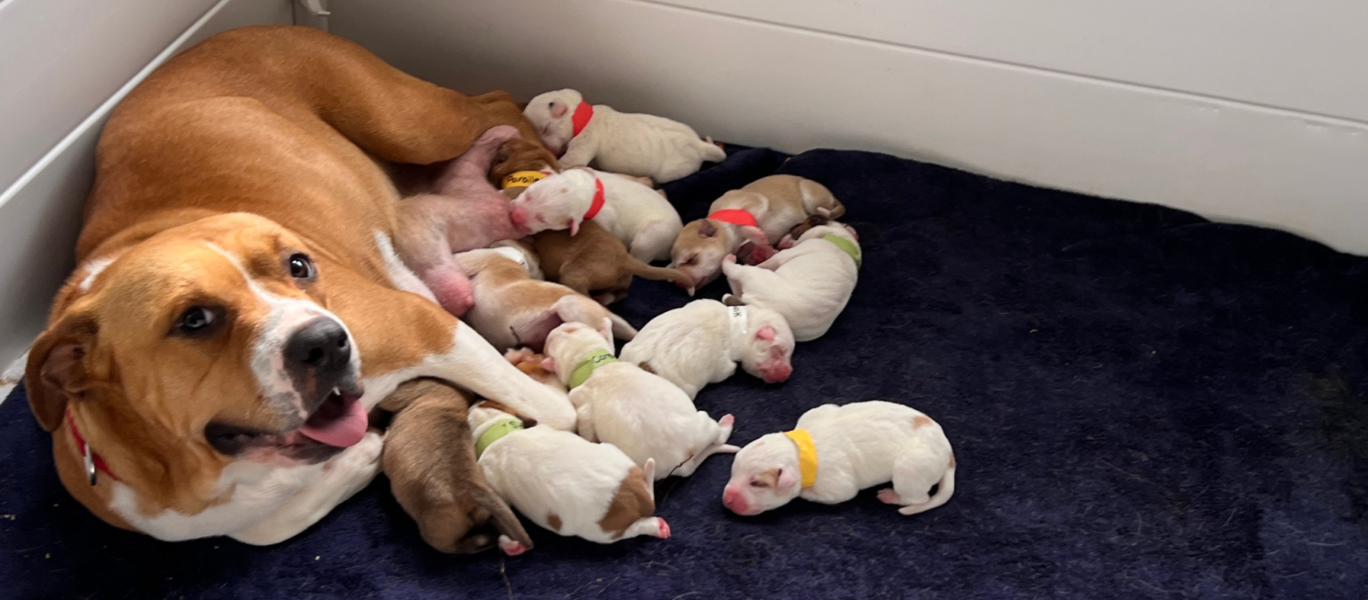
Here’s the truth: Ending near-term pregnancies will not solve the issue of shelter overcrowding. Those animals never took up the spaces in the shelter except in very rare circumstances. When they do give birth, they can also help many other animals live by allowing for orphans to be added to nursing litters. Pregnant dogs, especially the big ones, get out of the AAC precisely because they have puppies and APA! has a maternity program that can readily accept them.
Just opposing isn’t good enough: What we continue to advocate for is a shelter with a can-do attitude, stronger processes and oversight, better support for pets, and continued partnerships, not removing transparency or turning away from lifesaving.
*For clarity, we amended our previous statement that we accept every single pregnant animal AAC asks us to take in, to “does not decline,’ to account for uncommon circumstances where a pregnant animal had given birth in the short space between receiving and accepting the plea. When this occurs we take in both the mother and her litter whenever possible.
No. In fact, we spend far more on the care of puppies than we ever receive in adoption fees.
Average adoption fee: $250 per puppy (or $300 if treated for parvo, which costs us on average around $1,000+ for each pup’s treatment and care).
The $250 adoption fee is based on the average amount it costs us as a shelter to care for healthy puppies who enter our care after they’ve reached 8 weeks of age, including vaccines, tests for parvo and heartworm, flea/tick preventatives, dewormer, a microchip, veterinary check ups and any needed care for minor issues. In addition we provide spay/neuter before adoption, along with daily care.
However, we receive very few healthy, adoption-age puppies.
Think of it like this: There is a huge desire to adopt puppies and kittens all over the country. Northern shelters want them so that they can adopt more out and the public wants them. If all puppies that came from government shelters were healthy, then the obstacle that prevents instant home placement would be solved. These animals need organizations like ours to help them get into homes by providing interim care.
And, remember, our mission is to save the pets that have no other way out of the shelter and we love to do it. That means that all puppies and kittens that come to APA are already overlooked by all other rescue groups, the public and the city government.
Most puppies that come to us are underage or sick or injured since we take them from euthanasia lists. Some things we provide are:
veterinary visits for all who are sick or exposed to illness in their previous shelter,
vaccines every two weeks from birth until adoption,
preventatives for flea, gastrointestinal parasites and heartworm
Parvo treatment
Distemper treatment
Broken bone treatment
Maternity care, which includes isolation, serial deworming and vaccines, and sometimes hypocalcemia/eclampsia care, mastitis treatment
Spay/neuter
Intestinal foreign body removal
Additionally, we often reduce or waive fees during promotions. No shelter makes money on adoptions—it costs far more to provide food, housing, veterinary care, and staff support than adoption fees bring in. If adopting out animals were profitable, for-profit companies would already be doing it.
Austin Pets Alive! is a 501(c) (3) organization that has received the highest rating from the reputable charity reputation assessment site, Charity Navigator, which evaluates charities based on their financial health, accountability, and transparency. This includes but is not limited to program expenses, fundraising efficiency and governance.
Absolutely not. Breeding means intentionally creating animals for profit. APA! exists to stop shelter killing, not contribute to it. APA! will never breed dogs and cats. That would be hugely unethical when our job is to eliminate killing in shelters. We separate intact males and females. We also prioritize spay/neuter on pets that are not visibly pregnant but may have been living in a situation where rampant breeding occurred so we can stop them from becoming late-term pregnant.
Most people who come looking for a puppy/kitten will only adopt a puppy/kitten.This is especially true with puppies. Many people who come into an animal shelter with their heart set on a puppy will either adopt a puppy or, if they cannot find a puppy at the shelter, go to a breeder to buy a puppy.
That’s not always the case. There are times when a person goes into a shelter in search of a puppy and ends up adopting a senior dog, a 3-year-old tripod dog, or a cat! But from experience, it is more likely that when someone is set on a puppy or a kitten, they will only adopt a puppy or kitten.
The reason that adult dogs and cats are not getting adopted at AAC, but are at APA!, is that there is a big gap in necessary programming at AAC.
See chart in a lower section that details the programs necessary in our city.
No. We don’t believe anyone working in animal welfare wants that. It’s our understanding from everything we read, see and hear (including in the comments of our social media feeds) that Austin, along with most municipal shelters, DO NOT want to kill or euthanize a single pet. We’re talking about human beings who have devoted their lives and livelihoods to help pets. Our vets know the vets from other Austin shelters. They have taken many of the same classes. They are peers. They are humans. They are animal lovers.
Here’s the point of disagreement: When shelter staff see overcrowded kennels daily, two different operational approaches naturally emerge based on belief:
You believe you have no choice but to decrease the population through euthanasia; or
You believe you have to empty kennels by finding homes more efficiently/effectively
APA!’s concern is that the recent change to policy at city council removed a critical lifesaving safeguard: the requirement for transparency when pregnant animals enter the city shelter. Transparency allows rescues like APA! to step in. Without it, animals could lose their lives unnecessarily.
The simplest answer is that overpopulation and overcrowding are two different things, but if our social media folly taught us anything it is that we shouldn’t try to oversimplify nuanced topics. It’s no secret that many shelters across the US are overcrowded. And we also understand that there are many differences between nonprofit shelters like ours and most municipal shelters that do not have the resources that Austin Animal Center has.
It’s important to separate overpopulation from overcrowding.
Overpopulation means there are truly more pets than homes.
Overcrowding means shelters don’t have the systems to move pets into existing homes fast enough. Overcrowding indicates system capacity issues, operational inefficiencies, and resource constraints.
Think of it like an emergency room: if patients are stuck in hallways, it doesn’t mean there are too many people in the community; it means the system is overwhelmed, under-resourced and therefore unable to care for all of the people who need treatment.
Shelters are overcrowded. We want that to change. Asserting that shelters are overcrowded only because too many dogs and cats exist isn’t correct either. There is a huge difference between there being too many pets in shelters and there being too many dogs and cats in the community. One we can fix, one we can’t.
We know with appropriate processes, AAC could be reuniting more pets with owners, finding more adopters and fosters and we want to help them do that. It's an issue of how the shelter operates, not overpopulation of animals in our city.
We posted it to explain why spaying visibly pregnant animals isn’t a solution to overcrowding in Austin. But the video missed the mark, and we heard from our community that it was upsetting to keep it up. We didn’t mean to hurt anyone so we removed it, and our CEO and our Sr. Director who leads the marketing/communications team took responsibility for the messaging. Sometimes we move too fast when we should slow down and explain more clearly.
APA! has the largest shelter foster network in the country. We have the largest foster network in the country because we are relentless about asking for fosters. That’s marketing. The majority of our pets are in foster homes because that is far better for them than living in a shelter, so we work constantly to ensure they stay in homes. We don’t operate animal shelters to keep animals in shelters. We operate animal shelters to give animals temporary shelter until we can find them foster or adoptive homes.
It is important to note that simply because there are enough homes in Austin, doesn’t mean that those homes are going to do all the work to figure out which pets need them. It is truly the job of rescues and shelters to connect people to pets.
APA! is Austin Animal Center’s largest rescue partner and in 2024 took in about 17% of all animals (well beyond our required 12%) that enter the city shelter—that’s around one out of every six pets the city takes in.
When you also consider that many of the pets APA! takes from AAC are at risk because they are underage, sick, injured, or have significant behavior needs, you can see that APA’s support of AAC is one of a kind. This means we aren’t simply helping only with the number of pets at AAC, like when we took in 70 animals in two days this past July to help with AAC’s overcrowding. We are also taking on many of the pets that stay in care for a long time as they are being treated. Long shelter stays contribute to overcrowding, so transferring many of the animals that would otherwise take up shelter space for an extended period at AAC is an additional benefit of the partnership with APA!.
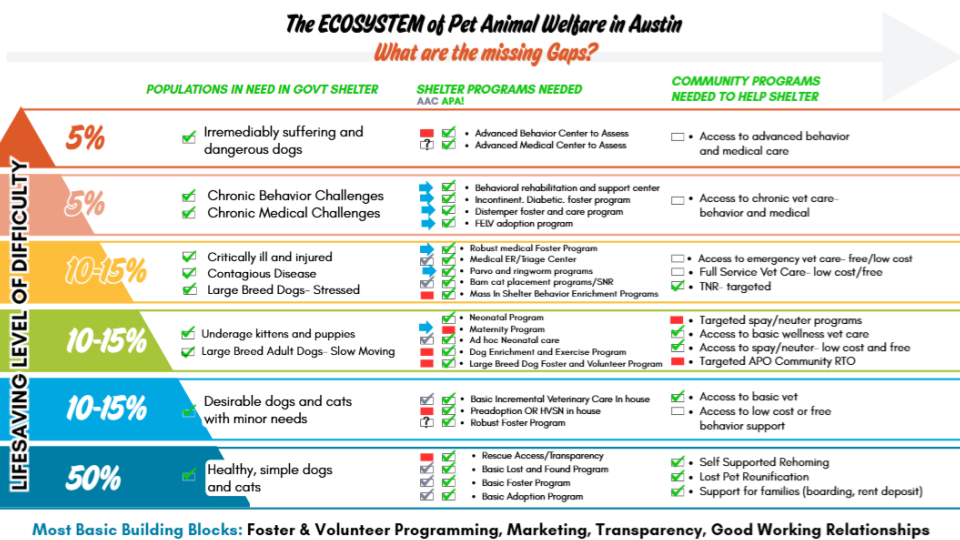
The programs that APA! has already set up have made it so that AAC, unlike every other government shelter in the US, does not have to create these programs to reach the highest lifesaving levels. In the chart below wherever there is a blue arrow, the city’s responsibility for a program has completely shifted to APA!. The red squares in the column called “shelter programs needed” under the AAC column are the ones that are critically needed still but have seen no forward movement. When we say we are advocating for programs that help the pets in the shelter, these are them. APA! has them for the pets that we take off of euthanasia lists and we have advocated for the city to have a $25M budget precisely so that they can build the building blocks necessary to treat animals well. The one red square in the APA column, is the program that was already in place to completely remove the city’s responsibility for that entire group of pets and the one that the city has just cut.
The issue would be catastrophically worse if the APA!/AAC relationship did not exist.
Overcrowding at AAC now is primarily due to larger-breed dogs and a lack of programs to support those dogs in finding homes. The result is dogs taking a long time to find homes, which reduces the shelter’s capacity to take in more.This is not a problem unique to Austin and it cannot be resolved by moving yet more animals to local nonprofits. Overcrowding is only resolved by addressing the challenges within the system at AAC. APA! has offered to help by sharing industry-proven best practices and proven strategies that are utilized around the country, including at APA! (and often created by APA!), to move animals through the system faster, even in shelters with fewer resources than AAC has. We have also offered to contract with the city to manage advanced care for all their difficult animals, relieving pressure on city staff, and giving them the capacity to focus their generous budget to move dogs to adoption.
In the chart above, if the city really wants to prevent adult large breed dogs from clogging their system, they could look to the list in the last section on the right - our community is truly missing key programs to prevent homelessness.
That's exactly the right question to ask, and we understand the skepticism.
The euthanasia numbers ARE real data points - and they're heartbreaking. But they tell us about system capacity and throughput, not about total market demand for pets.
Think of it this way: If emergency rooms have long wait times and people die in hallways, that doesn't mean there are too many sick people in the city. It means the system is overwhelmed and under-resourced.
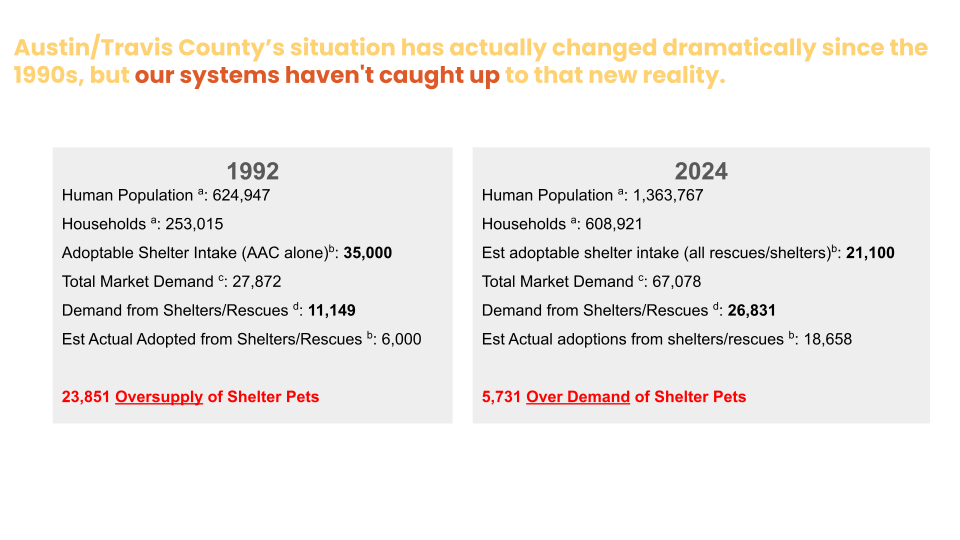
Here's what changed the thinking of APA!’s leader, who had founded Emancipet: Austin euthanized 23,000+ animals in 1992 when we had true pet overpopulation. Today, even with twice the human population, we're euthanizing far fewer animals. If overpopulation were still the issue, those numbers should have doubled, not decreased.
The euthanasia happens because:
Animals can't get out of overcrowded shelters fast enough
Potential adopters don't know about them or can't access them easily
We have process bottlenecks, not a shortage of homes
We’re not dismissing the euthanasia crisis - We’re saying we've been treating the symptom in shelters (too many animals) instead of the cause (system inefficiencies). The good news is that systemic problems have systemic solutions.
The question isn't whether animals are dying - they are, tragically. The question is: are they dying because there truly aren't enough homes, or because we can't connect them to the homes that exist?"
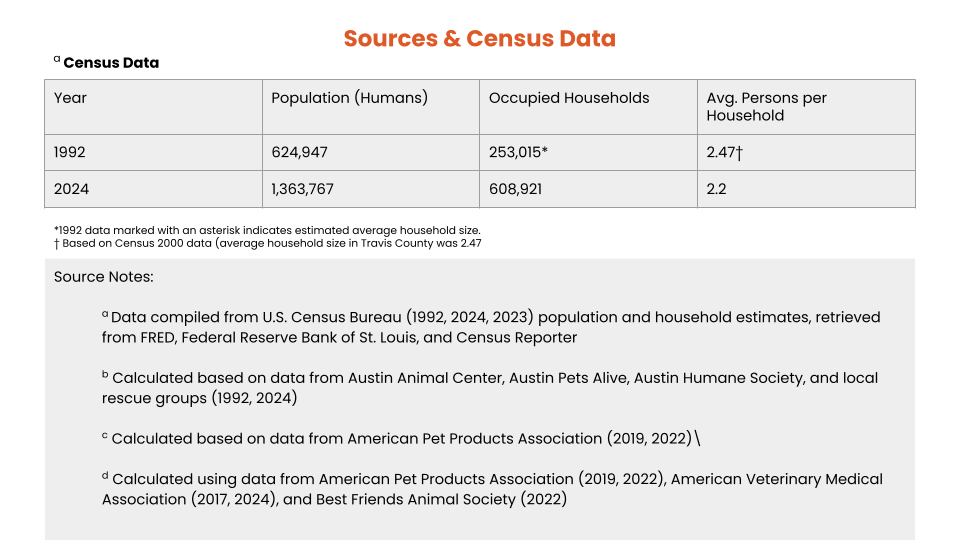
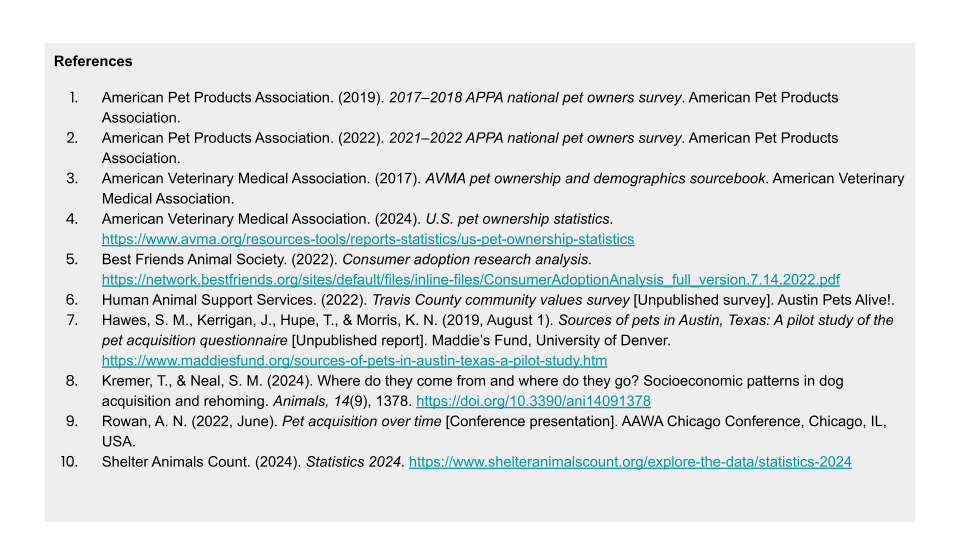
Here is some data. We want to make it clear that the data is all in disparate places which makes it so hard to find and to talk about quickly. We are in talks with national organizations on how this can be easier for people to find and compute for their own community. It needs further refinement but we share in the spirit of helping people find information. We have included source information at the bottom of this FAQ